
In banking, accessibility is a core quality attribute alongside security, performance and usability. It affects customer acquisition, digital adoption, operational costs, brand perception and regulatory exposure.
As mobile banking becomes the primary service channel, inaccessible experiences create measurable business friction for people with permanent disabilities, as well as customers facing temporary or situational limitations. It can also influence a prospective customer’s decision not to use a service at all and affect how that service is placed in rankings and comparisons.
In our previous article, we covered what accessibility means in banking and where WCAG fits in.
Accessibility in banking is a must-have
Disability affects a significant share of the population. An estimated 1.3 billion people, or 16% of the world’s population, live with a disability, according to the World Health Organisation. The number is even higher when temporary impairments, age-related limitations, and situational factors are taken into account.
Examples are countless: completing a transfer with one hand after an injury, trying to read account details with low vision, navigating a complex onboarding journey with cognitive difficulties, or confirming a payment with declining motor precision.
A banking application designed only for ideal conditions excludes a meaningful share of potential users.
In mobile banking app development, the goal is to create products that remain usable across a wider range of real-world situations. And the Web Content Accessibility Guidelines (WCAG) have become the global reference framework for achieving this. They define technical and design requirements around four principles: perceivable, operable, understandable, and robust.
These principles extend beyond websites and apply to mobile banking applications, authentication journeys, onboarding, customer support and digital documents.
Accessibility as a strategic business decision
Many organisations still associate accessibility mainly with legal compliance. However, the commercial impact tends to run wider than that.
Higher digital adoption. Customers complete onboarding, payments and service requests more successfully when interfaces are easier to understand and navigate. What is also important is that accessibility improvements frequently reduce abandonment for all users, not just those with disabilities.
Lower support costs. Poor accessibility leads to avoidable customer support requests: inaccessible authentication, forms that can’t be completed with assistive technologies, unclear error messages, insufficient colour contrast, and navigation that requires precise gestures. Every unsuccessful digital interaction increases the workload of contact centre teams.
Better product quality. Accessibility work tends to surface issues that affect usability more broadly. Clear navigation, consistent layouts, readable typography and understandable language improve the experience across the entire user base. Many accessibility improvements overlap directly with UX best practices.
Stronger customer trust. Financial services depend on trust. When customers can’t independently access accounts, complete transactions or verify information, confidence drops. Accessible products signal reliability and inclusiveness, as Which? has pointed out in its coverage of accessibility gaps in UK banking – both are becoming real differentiators in retail banking.
Accessibility implementation in banking products
Below are the four key areas that form the foundation of a successful accessibility implementation.
Research. Accessibility should be part of discovery from day one. Teams need to identify customer groups with different accessibility needs, high-risk user journeys, the assistive technologies customers actually use, and accessibility requirements for their target markets. Where possible, research should include users with disabilities directly, not just desk research.

UX and UI design. Design decisions determine much of a product’s accessibility. Sufficient colour contrast, scalable typography, predictable navigation, visible focus indicators, large touch targets, clear information hierarchy, plain language and accessible error handling. These choices reduce implementation effort later in development.
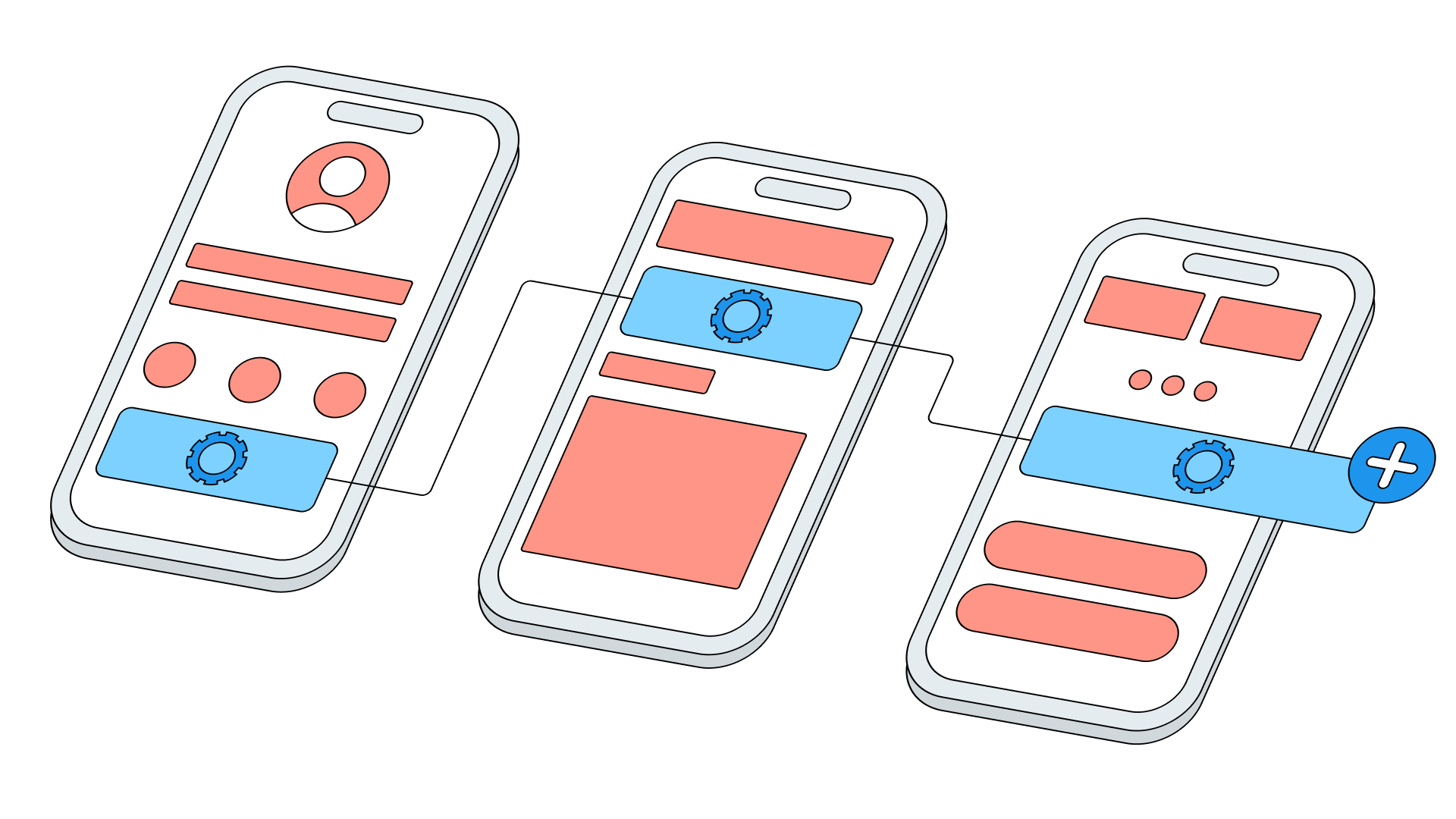
Development. Developers should treat accessibility as part of engineering quality from the very beginning. This includes supporting screen readers such as VoiceOver and TalkBack, providing meaningful accessibility labels, ensuring logical focus order, designing accessible forms, supporting dynamic text scaling, maintaining sufficient touch target sizes, and enabling smooth navigation without relying on complex gestures. These practices help banking applications remain usable across different devices, user needs and real-world conditions.

While many of the underlying accessibility principles are shared across web and mobile development,this practical guide explains several implementation techniques that complement the WCAG recommendations with concrete examples.
Testing. Automated tools catch only part of the problem. Comprehensive testing includes manual accessibility reviews, keyboard-only navigation checks, screen reader testing, mobile accessibility testing, and testing with users who rely on assistive technologies. Accessibility should be part of the release process in the same way security and performance testing already are.

Accessibility is most effective when it is built into every stage of product development. At FINANTEQ, we support clients throughout the entire process: from research and design to development, testing and audits.
What does accessibility cost?
Accessibility is often assumed to be expensive. In practice, timing matters more than the implementation itself.
Building accessibility into design and development from the start generally adds limited overhead, because many of the improvements align with existing UX and engineering practices anyway.
Retrofitting mature products is a different story. Late accessibility projects often mean redesigning interfaces, rebuilding navigation, modifying component libraries, updating design systems, rewriting forms and repeating QA cycles. Industry experience consistently points the same way: fixing accessibility issues after launch costs substantially more than addressing them during product development.
The cost of accessibility depends on the current state of your product, its complexity and the scope of improvements. If you’d like to discuss your project, we’re happy to prepare an initial assessment and estimate.
Risks of ignoring accessibility
Regulatory exposure. Accessibility regulation continues to expand across markets. In the EU, the European Accessibility Act (Directive (EU) 2019/882) has applied to consumer banking services, websites, mobile apps, and self-service terminals since 28 June 2025, covering an estimated 100 million people with disabilities across the EU. Financial institutions operating in or serving EU markets now carry a direct legal obligation on this front, not just a best-practice recommendation. Non-compliance can lead to investigations, remediation costs, and reputational damage.
Customer loss. For 57% of people with disabilities, accessibility is a decisive factor when choosing a banking or insurance provider, so customers who can’t independently complete essential banking tasks tend to switch. Accessibility matters most during onboarding, when customer acquisition costs are highest.
Reputation. Accessibility failures, such as an inaccessible login process, an unusable mobile app, inaccessible customer communication, and poor screen reader support, can spread quickly and affect brand perception directly for customer-centric organisations.
Technical debt. Delaying accessibility creates its own form of product debt. Each release adds inaccessible components that eventually need to be redesigned. Teams end up maintaining parallel solutions instead of building accessible systems from the start.

Measuring accessibility ROI
Accessibility rarely shows up through a single KPI. It contributes across several business metrics at once:
Many organisations first notice the ROI through fewer support requests and smoother customer journeys. Over the longer term, accessibility feeds into broader digital adoption and customer retention.
What accessibility looks like in practice
Many financial institutions are taking a proactive approach, doing far more than the bare minimum a compliance declaration requires. Banks’ accessibility statements increasingly describe how digital products are tested, which assistive technologies are supported and how customers can report accessibility barriers.
Common commitments include:
- compatibility with screen readers such as VoiceOver (iOS) and TalkBack (Android),
- keyboard and alternative navigation support,
- compliance with WCAG 2.1. Level AA,
- regular accessibility testing,
- transparent reporting of known accessibility limitations,
- continuous improvement based on customer feedback.
Accessibility should become part of the product strategy
The best accessibility approach is when it is part of product governance: requirements built into design systems, acceptance criteria in development, testing in QA, metrics tracked alongside other product KPIs, and continuous improvement.
Like security and performance, accessibility delivers the most value when it’s embedded throughout the product lifecycle. For banks building long-term digital relationships, accessible experiences are a competitive capability.
Key takeways
Accessibility is not only a compliance requirement. It is a product quality standard that directly influences customer acquisition, digital adoption and trust.
Designing for accessibility from the start is significantly more cost-effective than retrofitting existing banking applications after launch.
Successful accessibility programmes integrate research, UX/UI design, development, and testing into a single continuous process.
The business impact is measurable through many KPIs, such as higher task completion rates, fewer support requests, improved customer satisfaction and reduced regulatory risk.
As regulations such as the European Accessibility Act raise expectations across the industry, accessibility can become a competitive differentiator.
Banks that embed accessibility into product strategy create digital experiences that work for more customers, strengthen long-term loyalty and build more resilient digital products.
At FINANTEQ, accessibility is part of how we build digital banking products. It’s considered alongside UX, security and performance throughout development, whether we’re designing a new application or improving an existing one.
Ready to make your banking app more accessible? Contact us.